The Story of Gordy’s bowls: A Legacy in Wood
From Humble Beginnings to Craftsmanship Excellence
What began as a curiosity to delve into something he’d never attempted, and duplicate a set of table legs that were out of production, turned into Gordy’s passion project, dedicated to the art of segmented wood turning. In the late 1980’s he purchased a Craftsman wood lathe, turned the garage into a wood shop and commenced filling it with wood shavings. The simplicity of those first table legs motivated him to spend a lifetime seeking the limits of his innovation and imagination. Trying many paths in the wood turning world, segmented wood turning became what sparked his creativity and challenged him most. His imagination and innovation were only constrained by the availability of wood and the size of his lathe. For over thirty-five years he intricately crafted hundreds of unique pieces, including exquisite bowls, charming ornaments, and unique birdhouses for friends and family. Every piece exhibits his dedication and deep love for woodworking.
Early Life
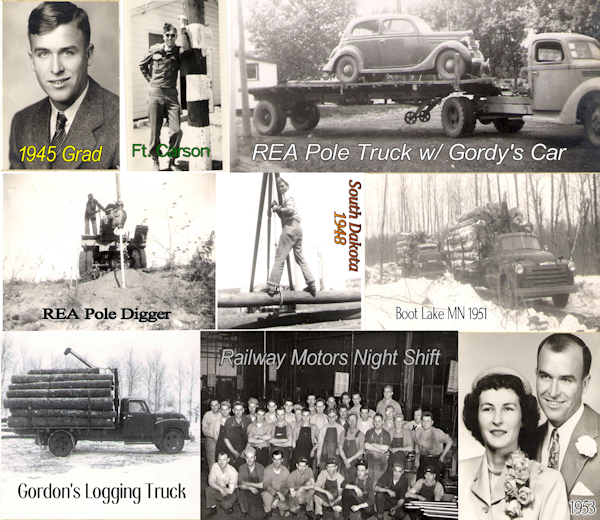
Born in the 1920’s to a shopkeeper and his wife in Palisade, Minnesota, Gordon and his sister grew up embracing hard work and self-reliance. His parents had immigrated from Sweden, accompanied by many of their siblings, with each family unit starting a variety of family businesses. While Gordon grew up helping in the general store, he spent a few summers working with his uncles building roads and logging. After serving in the Army during WWII he returned to work for the Franzen Brothers, one of the family businesses, building a new transmission line spanning South Dakota. That family company grew and was acquired by Brink Constructors of Rapid City, who have now become part of global giant Quanta. In 1949 Gordon, and his Brother-in-law Gene, went on to each buy a truck and modify them to start a venture into a logging and pole hauling business. In late 1951 he resettled to a village in southern Minnesota, where his parents had bought a general store that he helped out at. Finding work as a night welder for Fairmont Railways Motors he also met and married the love of his life. Gordon had found time during this period to get his pilots license, but his new bride put her foot down on both the aerial endeavors and night work, leading to a career in carpentry that spanned over fifty years.
Work Life
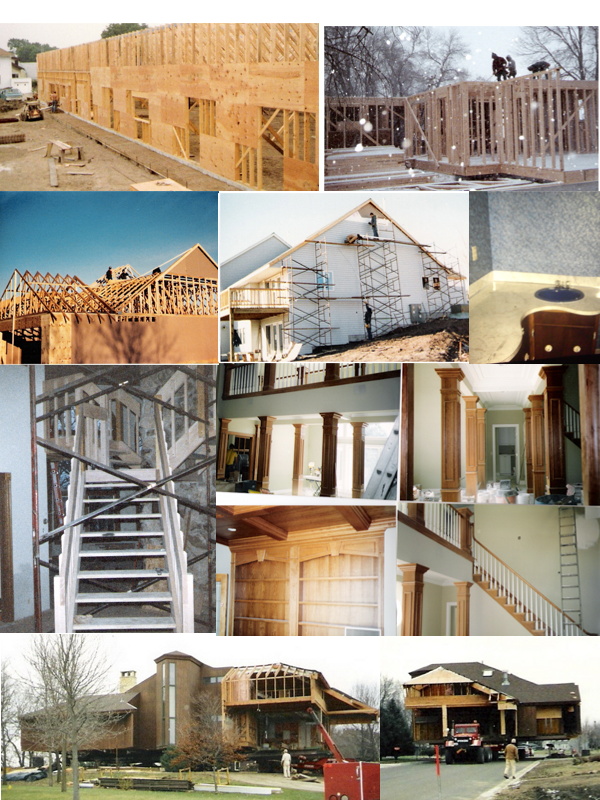
Finding employment with Helland Lumber he went on to make life-long friends as he learned and developed his carpentry skills over the next decade and a half. Starting out building corn cribs and barns, it wasn’t long until Gordon moved on to commercial projects, then construction of complete homes. He expanded on those skills working in a larger market for Christensen Lumber, where he built not only custom homes, but also excelled at finishing work for many of the most expensive homes in the area. While there Gordon’s had one of his most challenging out of the norm work projects, overseeing moving one of the largest lake homes in the area to another lot, and it went well. Two other interesting projects were; fabricating a custom bar top out of fifteen hundred pieces of wood and building a home where nearly all the walls were at other than ninety degree angles to each other. When his good friend and work colleague Keith, started up Hertzke Construction and Millwork, Gordy gladly came on board. Times were tough for the young business, but the integrity and dedication displayed by everyone helped fuel it’s success. They not only succeeded, but the company was one of the only lumber and millwork companies in the area to remain in business. While there, Gordon helped to train many of the carpenters, forming many lasting friendships in the process. An example of his humor; he kept a mannequin hand in his tool box and the first time you asked him for a hand, that is what you’d get. While Keith and he continued to remain close, Gordon eased into partial retirement in the late 80’s, drawn to the idea of snow birding during the winter. Fully retiring in 2003 from paid work, he continued to help out both family and friends for years to come, and spent many winters in more agreeable climates.
The Shop
After renting for years, Gordon and Donna bought her childhood home in the 70’s and moved the clan in. The house and a small detached garage had been built circa 1900 and needed many upgrades. Gordy used all his carpentry skills, along with the electrical and plumbing knowledge he’d picked up along the way, to began an extensive remodel of the whole house. Also during this time he began turning the tin sided garage, which had been built to house a Model T sized car, into a work shop. He raised the ceiling, insulated the walls using cardboard, updated the wiring, built cabinets, installed a wood stove and fabricated a wood storage area off the ceiling. Next, he acquired a unique table saw, a drill press and a very nice planer, but ended up building his own band saw and a sanding table. When he bought the lathe it required a complete rearrangement of the garage and the wood stove eventually couldn’t be used safely, limiting his shop time to only warm weather.
As Gordy’s skill on turning bowls improved he found the basic tools that came with the lathe were too soft or inadequate for the designs he was attempting, so he began building his own. He got some Model A leaf springs and fabricated replacements for the standard ones and also a few unique to his needs. Now he was able to gouge out a bowls rough shape in record time and the new tools held their edge far longer. As his tool and wood inventory grew, his work space shrunk, quite a bit, so he devised a system. On the table saw he would cut each of the segment pieces, which he’d then glue into rings at his work bench beside the saw. Hanging those to dry, he’d glue together a few rings done earlier that week until they formed the rough body of the bowl. In the confined space he only needed to twist his chair around to the lathe and could turn out a bowl from the rings glued up a day or so before. Afterwards he proceeded to finish and stain those bowls, and finally brand his GRF.
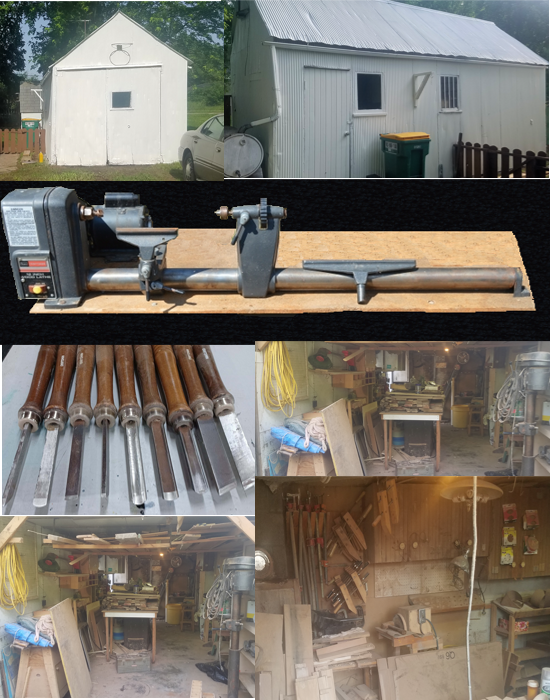
His Gifted Start
Even before he retired Gordy spent time designing and making templates to allow repetitive cutting of the segment pieces for each diameter of bowl he would make. Bartering with neighbors and farmers for wood, by building various projects for them, was the start of his inventory. As his creations became well accepted, they now came to barter for a bowl in return. He was able to accumulate quite a variety of wood types, with his nephews providing some of the more exotic woods. During the first years of turning bowls he scoured magazines, then later the internet, for ideas and is where he discovered segmented bowl turning. This opened up a whole new realm of options, allowing him to waste less of the wood and provided him a fitting challenge.
Gordon was one of two people I’ve known who could visualize in three dimensions, making his complicated design ideas much easier to create. To him much of segmented wood turning was just math problems, which he loved and excelled at solving. While the artistry aspect was challenging in the beginning, he worked hard to expand and refine his art. What he most appreciated was how the grain in each wood species could make his design elements stand out, and strived to utilize that in every piece he created. Gordon never copied another’s bowl, he used them for inspiration and tried to improve on a few, usually with his own twist. His achilles heal was covers or lids, anything that sealed the top. Due to the various characteristics of wood, and the humidity, it is very difficult to prevent those lids or covers from warping and cracking, yet he persisted and succeeded many times.
The Bowls
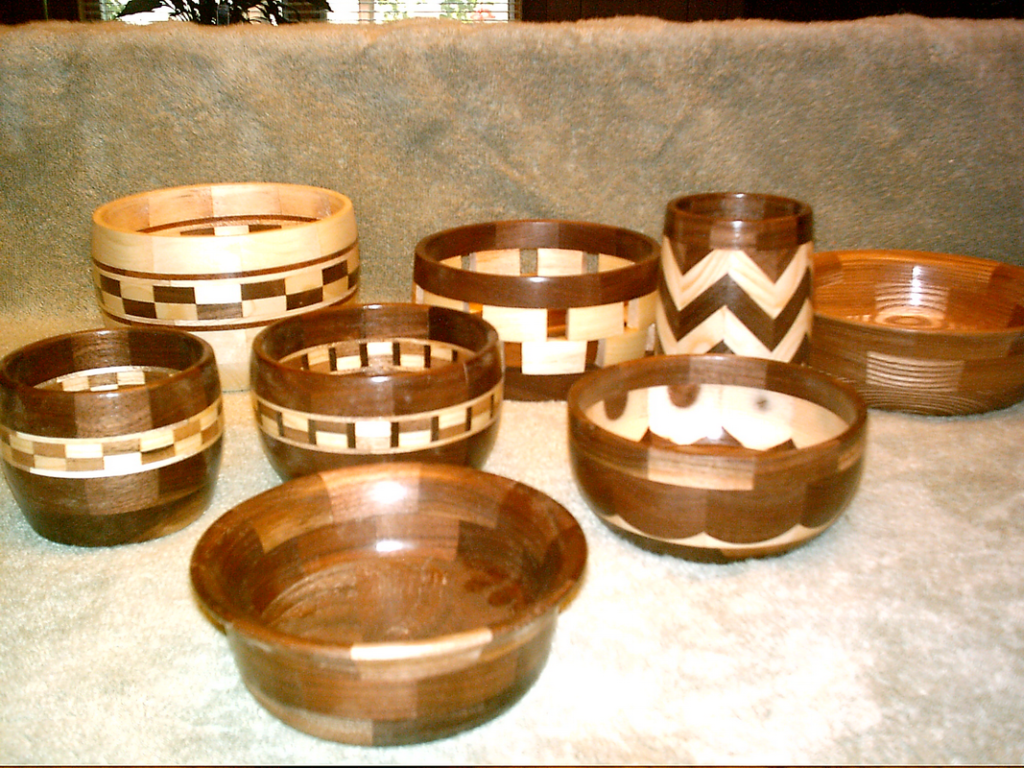
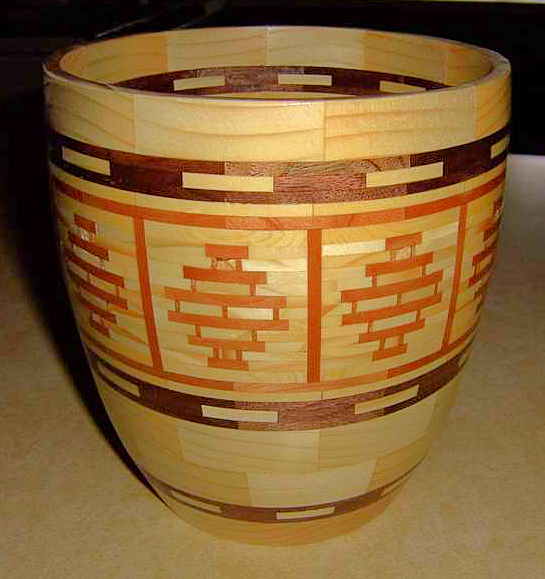
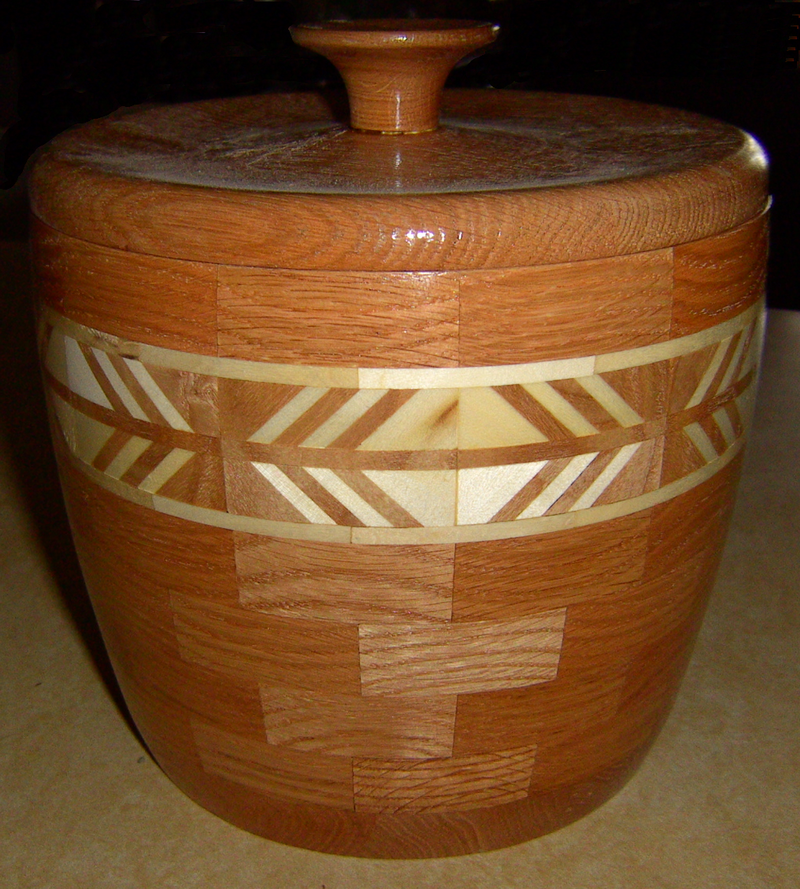
Once Gordon got through the cheap glue, gouge too deep, flying off the lathe and hitting the ceiling phase, things went much better. The man had the patience of a Saint, never getting upset with inanimate objects, altho animated humans could be a little different story. As he developed the technique and skills of wood turning, he sought out wood pieces with unique grains and spalting to incorporate into his designs. He created many bowls with very unique pigmentation and zone lines, some were even surprises. As his focus shifted more to segmented bowls, Gordon began to enjoy creating bowls from a mixture of grains, coloring and segment size. Trying out patterns that really showcased the beauty of the pieces he used. After an offhanded challenge he tried using the segments to create names in the bowls, making quite a few personalized ones. While each bowl was unique, there were some repeated themes people would inquire about. Overall, the crowd favorite was the one he named the “Steerhead”, with the “Name” ones, and the “3D” ones being highly sought after. There were a few other named ones, a couple of the more memorable ones: “Frustration” a difficult one he added a note to with his labor time and costs, and “Emergency” where he also added a note detailing his doctor visit from an accident while turning it. As the effects of aging were catching up to him, Gordon took on a last great challenge, making his largest bowl yet, a 270+ segment piece. One of which is pictured to the right.

Birdhouses, Ornaments & Knick-Knacks
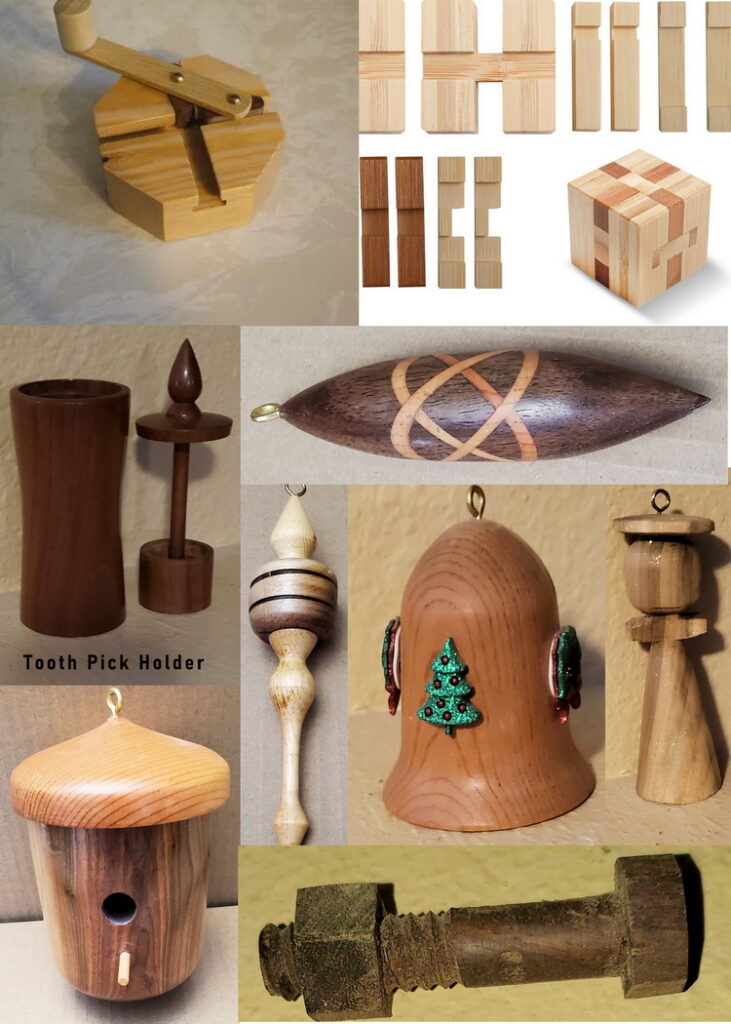
Gordon always loved building unique and intriguing wood items. He made multiple wood puzzles and games over the years for the kids, wood tool boxes for him and a variety of home decorations. A big family favorite was the classic “Bullshit Grinder”. It was a flat block with grooves cut in that two pieces of small blocks could travel in back and forth while connected to a linkage with a handle that you cranked. It didn’t do anything worthwhile, hence the name. Photos of a similar wood block puzzle and BS grinder are to the left, with actual photos of his other works, including one of the many wood bolts w/nut he made. Gordy had a collection of 16 egg shaped pieces turned from different species of wood, to show each ones unique look. His eldest tried to hoax him with a egg shaped petrified wood one as a joke. He created various types of tooth pick holders, pencil cups, miniature wood birdhouses and even crafted some beautiful, small wood flowers. While for the holidays he turned out quite a variety of ornaments, including various wood bells, which he’d usually add decorations to. Finally Gordy made his famous Angels, of which some were colored and most had glitter. Then he built a unique wood tree that his youngest could display a few of her ornaments on. Gordy devised a very unique piece he called his “Inside/Out” ornament, a segmented piece where he hollowed out part of it, cut it in half and re-glued it with the pieces reversed.
Even while turning he would build side projects and spend down time bringing his other ideas to life; one was a spinning wood top that played tones, then he attempted a wood bodied pen, and after many tries turned out a working upside-down wood top. For his family he always made time for special projects. He built beautiful dressers, china cabinets, stools, desks, picture frames, and knick-knack shelves. We were so Blessed to have him in our lives.